Antennas for CORTEX transmitters: how to choose and install them
Which antenna a GSM/LTE transmitter needs and which one suits a VHF/UHF radio system, when an indoor antenna is enough and when to fit an outdoor or directional one, and what to avoid when installing a radio transmitter.
CORTEX antennas at a glance
The antennas fall into two groups: GSM — for RT4-5GP/4, RT4-5GL/4 and other CORTEX GSM devices, and VHF/UHF radio — for radio transmitters, receivers and repeaters.
| Antenna | Type | Use |
|---|---|---|
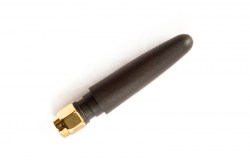
| ST1-1G | Indoor GSM | Compact antenna for RT4-5GP, RT4-5GL and other GSM devices, indoor mounting |
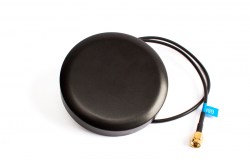
| GP1-G | Outdoor GSM, SMA connector | Improves reception in weak coverage areas |
| ST1-1 | Indoor VHF/UHF | For CORTEX transmitters and RS-63 system components; supplied with the RR-63RT receiver |
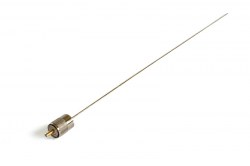
| GR-3 | Outdoor VHF/UHF | Higher gain for a wide coverage radius |
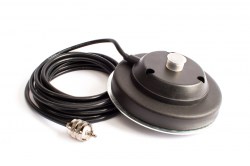
| UHF-M | Outdoor UHF | Long-range links: RS-4000 and base stations |
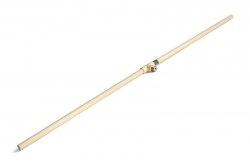
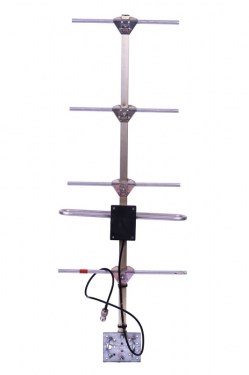
| Yagi | Directional UHF/VHF | Remote sites: high gain, narrow beam |
| Split 2/3/4 | Antenna splitter | Connects 2, 3 or 4 RR4000d, RR4000h receiver modules to one antenna |
GSM transmitter: indoor or outdoor antenna
- Start with the ST1-1G indoor antenna and power the transmitter on.
- Check the GSM LED: green — high signal, yellow — medium, red — low.
- For an exact figure, send SMS 99.C3: a CSQ of 15 to 20 in the reply is acceptable, 20 to 30 is good.
- If the signal is low or CSQ is below 15, fit the GP1-G outdoor antenna with an SMA connector and place it where reception is better.
The RT4-5GP/4 and RT4-5GL/4 have an SMA antenna connector. For more on checking the link, see “Checking a GSM transmitter”.
Radio systems: from an indoor antenna to a Yagi
- The standard RS-63 kit includes an ST1-1 antenna for the RR-63RT receiver; several types of external antennas are available to order.
- If a site is far from the receiver or the signal is weak, use an outdoor antenna: the higher-gain GR-3, or the UHF-M for long-range links in RS-4000 systems.
- For individual remote sites, use a directional Yagi antenna. Because of its narrow beam it must be pointed at the receiver.
- The RX_LEV LED on the RR-63RT receiver shows the signal level: during reception it lights red for a poor signal, yellow for medium and green for good.
- To connect several RR4000d or RR4000h receiver modules to one antenna, use a Split splitter with 2, 3 or 4 outputs.
Installing a radio transmitter: rules from the manual
These requirements come from the installation manual of the RT4-5se radio transmitter (139–174 MHz, up to 5 W):
- Connect the antenna before applying power — directly to the antenna connector (whip) or via coaxial cable.
- Choose the transmitter location where the receiver picks up its signal best.
- Keep the wires from the battery to the transmitter as short as possible.
- Do not run the wires to the terminal block near the antenna, and never along it.
- With a dipole antenna, lead the cable away at right angles to the antenna for at least 1 m.
- Equipment should be placed in a metal box; with a whip antenna the transmitter housing must be in direct contact with the box.
⚠ Never power a radio transmitter without an antenna connected.
Outdoor installation
Outdoor antennas are often installed on roofs and masts. CORTEX carries out this work: design and manufacture of antennas and antenna masts, antenna installation at height, as well as lightning protection, surge protection and grounding.
Documentation
- 📄 RT4-5se v4.1.1 installation manual (Russian)
- 📄 RT4-5se v4.1.1 installation manual (Latvian)
- 📄 RS-63 VHF system manual (Russian)
- 📄 RT4-5GP/4 V51.xx installation manual (Russian)
Learn more
- All antennas in the catalog →
- Antenna and mast installation, lightning protection — CORTEX services →
This guide is based on the CORTEX manual. If you have questions, call technical support: +371 26485444 (24/7).