RS-63 VHF system: up to 63 sites on one receiver — components and how it works
RS-63 VHF is an addressable radio alarm system for local security: up to 63 sites send alarms by radio to one receiver. What the system consists of, where the receiver passes the information on and how it monitors the link to the sites. Based on the RS-63VHF V1.2 and RR-63 rev2 (2023) manuals.
What the system is
- A set of site units and a receiver: up to 63 site units work with one receiver, each with its own address.
- Operating frequency range 139–174 MHz, range up to 10 km.
- Reliability comes from periodic channel testing: every site unit regularly sends a test message.
- The site sends the receiver the state of the alarm loops, power and battery, and arming and disarming.
Components
| Device | Purpose |
|---|---|
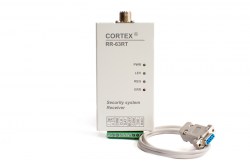
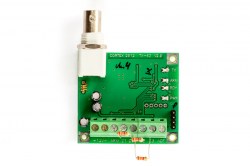
| RR-63 receiver | A concentrator: collects messages from the site units and passes them on |
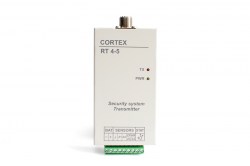
| RT4-5/63 site unit | Collects information about the site from its own inputs and sends it by radio; monitors its own supply |
| TX-63/RT transmitter | Connects alarm panels of other makes to the system: 3 alarm signals, status, system faults |
| IM-8 indication board | Shows the state of 8 sites with light and sound |
| RM-4 relay module | Outputs for actuating devices for 4 sites |
| Antenna | The standard kit includes an ST1-1 antenna for the receiver; external antennas to order |
Where the receiver sends the information
| Where | Through what |
|---|---|
| To the monitoring centre | Through a radio, GSM or I-Net transmitter connected to the receiver |
| Local monitoring on a computer | Over the RS-232 port to the Win SC monitoring software |
| Local monitoring without a computer | IM-8 boards and RM-4 relay modules on the RS-232 port |
The computer and the boards with relay modules use different data formats, so they cannot be connected to the receiver at the same time. Boards and modules can work together.
Registration and link monitoring
- The receiver registers a site unit automatically — on the first test signal from it.
- After registration the receiver watches for tests from that address. If a test does not arrive in the set time, it generates a “no test” message on behalf of that site.
- If there are no messages for a long time, the receiver removes the address from the registered list and generates a “no link” message.
- Information messages are processed whether or not the unit is registered.
- In the RS-63VHF V1.2 manual the service codes are: FE — no test, FD — no link, FC — successful registration.
RT4-5/63 site unit
- Inputs: Z1 — delayed zone, Z2 — instant, ZP — 24-hour, ARM — arming and disarming. A jumper can make all inputs equal.
- Supply 11–14 V; it is recommended to power the unit directly from the battery that serves as the backup source.
- When the supply drops below 10 V the power indicator starts blinking and a message is sent to the receiver.
- Carrier power is not more than 5 W; 3 to 6 transmissions are made per event.
- Addresses, the test interval, delays and event codes are programmed by the manufacturer.
Frequency and licence
- The user provides the radio frequency for the system.
- In Latvia a radio frequency use permit is required to use the equipment; it is issued by VAS “Elektroniskie sakari”.
Installation recommendations
- Choose the place for a site unit by the best conditions for the receiver to receive its signal.
- The wires from the battery to the site unit must be as short as possible.
- Wires to the terminal block must not run near the antenna, and never along it.
- With a dipole antenna the cable is led away perpendicular to the antenna for at least 1 m.
- Connect the antenna before applying power to the site unit.
- Reception quality is shown by the signal level indicator on the receiver: yellow or green is acceptable; red means the signal is too weak and messages may be lost.
Documentation
- 📄 RS-63VHF V1.2 installation manual (Russian)
- 📄 RS-63VHF V1.2 installation manual (Latvian)
- 📄 RR-63 rev2 receiver installation manual, 2023 (Russian)
- 📄 RR-63 rev2 receiver installation manual, 2023 (Latvian)
Learn more
- Connecting the RR-63 rev2 receiver →
- TX-63/RT transmitter: connecting a third-party panel →
- Antennas for CORTEX transmitters →
- RS-63 VHF equipment in the catalog →
This guide is based on the CORTEX manual. If you have questions, call technical support: +371 26485444 (24/7).